
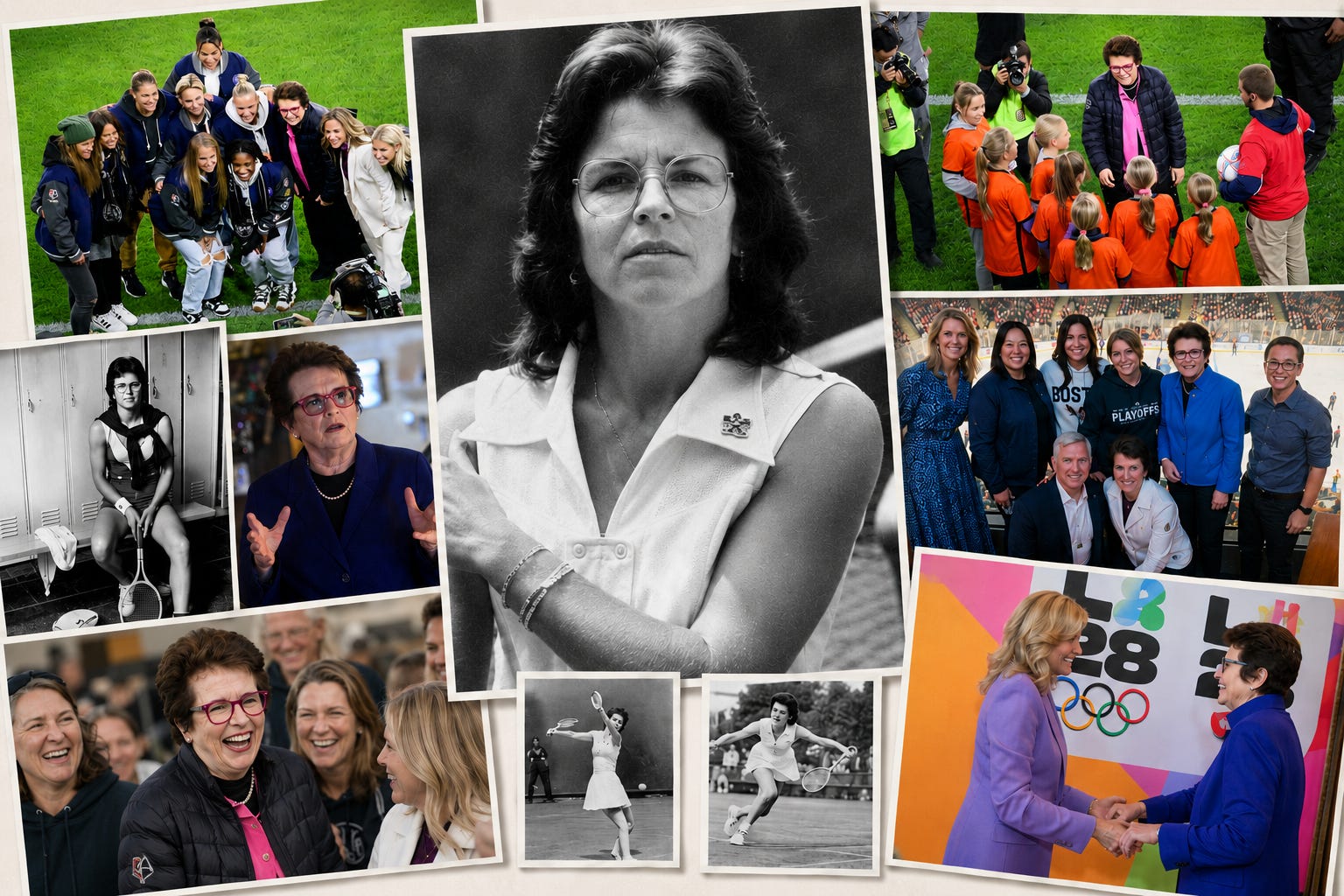
This week, Billie Jean King is graduating from Cal State LA.
She enrolled decades after leaving school to pursue tennis. She is 82 years old. She will walk across a stage and receive a diploma she has spent a lifetime proving she didn’t need, and doing it anyway, because she believes in finishing what you start, and because she has never stopped being a student of the world she helped build.
Part of her senior year included classes with incarcerated women enrolled in Cal State LA’s Prison Graduation Initiative. She described it as life-changing. She also had to write an essay on Title IX. She helped pass it.
I can’t stop thinking about what that image means. Not just the diploma. The whole picture. A woman who changed the world, still being changed by it. Still in the room. Still learning.
— — —
Women’s sports right now is running two races simultaneously.
The first race is the one everyone is watching. New leagues. New teams. New venues. Record attendance. Record viewership. A generation of athletes arriving with agency and voice and platform. The WNBA just closed a $3.1 billion media rights deal. The Golden State Valkyries became the first billion-dollar franchise in women’s sports history after one season. There is real capital flowing into real infrastructure for the first time. The energy is extraordinary and the momentum is real.
The second race is the one almost nobody is talking about. It is the race against the clock. The window to capture what the first generations built, to transfer the institutional knowledge, to build the infrastructure for the relay, before that window closes.
Both races are happening right now. Both are urgent. Everyone is watching the first race. Not enough people are running the second.
This is about the second race.
— — —
Around the same time BJK is graduating, one of the most celebrated coaches in the history of women’s volleyball posted publicly that he couldn’t find a professional championship match. Not that it wasn’t competitive. Not that it wasn’t worth watching. That he couldn’t find it, couldn’t locate where or how to watch a semifinal in a league built on foundations he helped lay.
The comments on that post told the whole story. Others had found the match but not through a straightforward path. Some found it on one platform. Some found it through a different service. Nobody had a clean answer. The information was scattered across apps and streaming services and league websites that don’t talk to each other.
Around the same time, one of the most prominent voices in women’s sports called out the same league’s championship match publicly and asked: how does nobody know about this? A million dollar prize, split by the winning team, and it hadn’t broken through. She was right. There had been hardly any coverage.
Two of the most connected people in women’s sports. Both pointing at the same thing. The connective tissue is missing.
One of the architects of the sport couldn’t find the league playing it. That is not user error. That is what fragmentation looks like. And it is a call to action.
— — —
Which brings me back to BJK and what her graduation actually means.
Ask her what drives everything she has built, and she always comes back to the same thing. “Relationships are everything.” Not strategy. Not leverage. Not positioning. Relationships.
It sounds simple. It is not simple. It is a practice, sustained across decades. Most people who achieve what she has achieved develop a protective polish, a performance of themselves. By every account, she doesn’t have that. The curiosity is genuine. The warmth is genuine. In forty years of covering tennis, one journalist wrote in Inside Tennis, he had never encountered a more curious and restless mind.
Call it Kinger’s Cabinet, named for Kinger as Julie Foudy calls her. Not a formal structure, no bylaws, no board, no official membership. But something real nonetheless: a network of trusted relationships, built over decades, through which introductions get made, next generations get prepared, tables get populated with the right people, and the relay gets run.
It exists because she built it. It is sustained because she tends it. And it works because of something that cannot be faked or manufactured. By every account, she talks to the servers at every event. She checks in with every sport at the Women’s Sports Foundation Gala. She takes the time, every time, with every person in the room. The servers remember. The athletes remember. The staff remember. The incarcerated women in the Cal State LA classroom remember. That accumulated weight of genuine attention, over decades, is how you build something that lasts. That is not incidental to Kinger’s Cabinet. It is the cabinet.
— — —
There is a related observation worth making carefully, because it is not a criticism of the current generation of players. It is an honest assessment of where the women’s sports movement is.
The generations that built women’s sports forged their cohesion through shared struggle. The equal pay fight. The years of being told the audience wasn’t there. The locker rooms that were afterthoughts and the budgets that were insults. Those fights created common cause. The common cause created connective tissue. The connective tissue held the movement together through the lean years and gave it the foundation to become what it is now.
The current generation of players is extraordinary. The talent is real. The platform is unprecedented. And the current generation is still finding its footing in the broader leadership sense, still working out who will step into the public-facing roles, who will say the things that need to be said, who will bring everyone else to the table, who will carry the movement not just on the field but off it.
There are signs of it. The WNBA Players Association’s successful negotiation of a transformational new collective bargaining agreement, securing a 20% revenue share and significantly higher player compensation, required exactly the kind of collective solidarity and shared cause that has always moved this movement forward. The players organized. They held together. They won something historic. And notably, they won something for the generations before them too — recognition payments for WNBA veterans and retired players based on years of service, along with expanded retirement benefits. The current generation did not just negotiate for themselves. They negotiated for the women who built the league. That was connective tissue at work. That was the relay running in both directions.
Part of that finding of footing is also generational in a specific way. Earlier generations of athletes often did not always know they could advocate for themselves. They knew how to perform. They knew how to compete. They did not always know they could say no, or say I am not okay today. The current generation is taking that further, in part because of the sacrifices and work that came before them. That is a healthy and beautiful thing. But it cannot be counted on to keep happening organically. The conditions that make it possible have to be built and tended deliberately.
The conditions that forged cohesion in earlier generations are genuinely changing. NIL has created powerful incentives for individual brand-building from the moment a player arrives in college, sometimes before. The transfer portal has made movement between programs closer to norm than exception. Both have opened real doors for athletes. Both have made the organic continuity that once built team identity and transferred institutional knowledge much harder to sustain. On top of that, more women are entering the professional ranks directly, bypassing the college experience that historically served as a place where mentorship happened, where institutional knowledge transferred, where team identity was built across years. These are not bad developments. More opportunity is genuinely good. But they change how the connective tissue forms. What used to happen organically now has to be built deliberately.
There is also a harder truth worth naming. Social movements often lose momentum after their founding victories are won. The generation that fought for something understands viscerally what was at stake. Later generations inherit those gains without the struggle, which is the whole point, but also means the urgency can fade. Title IX and women’s rights overall are under active threat right now. The gains that feel permanent are not permanent. The relay has to be run in every generation or the ground that was won gets lost and the ground that could be won is not taken.
— — —
There is one more element worth naming, and it too requires care.
Movements don’t just need infrastructure and knowledge transfer. They need leaders willing to carry disproportionate weight, to return when they might have stayed gone, to testify when silence was easier, to put their names and bodies on the line for something larger than their own careers. Billie Jean King did this. The generations that fought for equal pay did this. These acts of sacrifice created the conditions for everything that followed.
We are seeing it still. When Kelsey Plum signed with the LA Sparks, she took a pay cut so the remaining salary could be used to build a stronger team around her. She didn’t have to do that. She chose to. That is the baton-carrying behavior the movement needs, not manufactured, not demanded, freely chosen in service of something larger than individual gain.
These sacrifices cannot be engineered or demanded. But they can be recognized, resourced, and supported. And that cannot happen alone. The connective work happens in community. Community cannot be assumed. It has to be built, nurtured, and shared, deliberately, over time, by people who understand what is at stake.
That is not a call for anyone to carry more than they can. And when that person cannot carry more, the movement stalls. That is not their failure. That is the cost of missing infrastructure.
Some sports are in a position where a new professional league’s viability depends on a specific iconic figure choosing to return, to lend their name and presence and following to something that cannot yet sustain itself without them. That is not a criticism of anyone. It is a structural observation about what happens when the connective tissue is missing. The weight falls on individuals rather than being distributed across an ecosystem.
Volleyball faces a version of this challenge. Without a singular iconic figure to anchor a professional league, let alone multiple leagues, the connective tissue work becomes even more urgent. The infrastructure has to do what a single iconic presence might otherwise provide. It has to be distributed, deliberate, and durable.
— — —
I want to be careful about what I am suggesting, because I am not sure if it is a new organization or a formal institution or another conference. Perhaps it already exists in some form. I hope so. I am not confident it does.
What I am suggesting is something more deliberate than what I think currently exists. Kinger’s Cabinet, formalized. Resourced. Documented. Built to outlast any one person. A network of experienced leaders who built, and are building, this movement, actively and intentionally doing the connective work: having the conversations, sitting at the tables, making the strategic introductions, preparing the next generation not just to play but to lead. Planning for who will fill their shoes when the baton must be passed. And building the conditions, the community, the trust, the permission structures, that make it possible for the next generation to ask for what they want and need, to visualize and to demand more, without being told that asking is weakness, that they are too much, or that they are not enough.
It will require relationships. Real ones, not transactional ones. Sustained over time, not activated for a moment. That is the hardest thing to institutionalize. And it is the most important.
If Kinger’s Cabinet doesn’t already exist, in some real, sustainable form, building it is among the most urgent priorities the women’s sports movement faces.
The clock is running on both races. The growth race and the relay race. We are winning the first. We have not yet fully committed to the second.
— — —
Billie Jean King has said many things worth remembering. One I keep coming back to, “pressure is a privilege.”
The pressure to get this right, to connect the pieces, to transfer the knowledge, to build the infrastructure that matches this moment, is a privilege. It means something worth protecting is actually at stake.
Kinger’s Cabinet has existed informally for decades. Built on relationships. Sustained by earnestness. Carried by one woman and the people around her. The relay is already underway. The question is whether we build the infrastructure to ensure the baton doesn’t get dropped when she is no longer the one carrying it.
Congratulations, Billie Jean. On the diploma, and on everything else. Thank you for all of it.
— — —
— — —
Sources consulted include USA Today, The Independent, Inside Tennis, and Welcome to the Party.
Images sourced from Wikimedia Commons and the Library of Congress. Each image is used under its respective Creative Commons or public domain license. Full attribution available on the original file pages.
I'm just happy I can finally watch women's soccer on TV on a regular basis! We've come a long way, but I agree we need to keep going. Love Abby, Julie and Billy! My heros. Let's GOOO 🎉🥳