
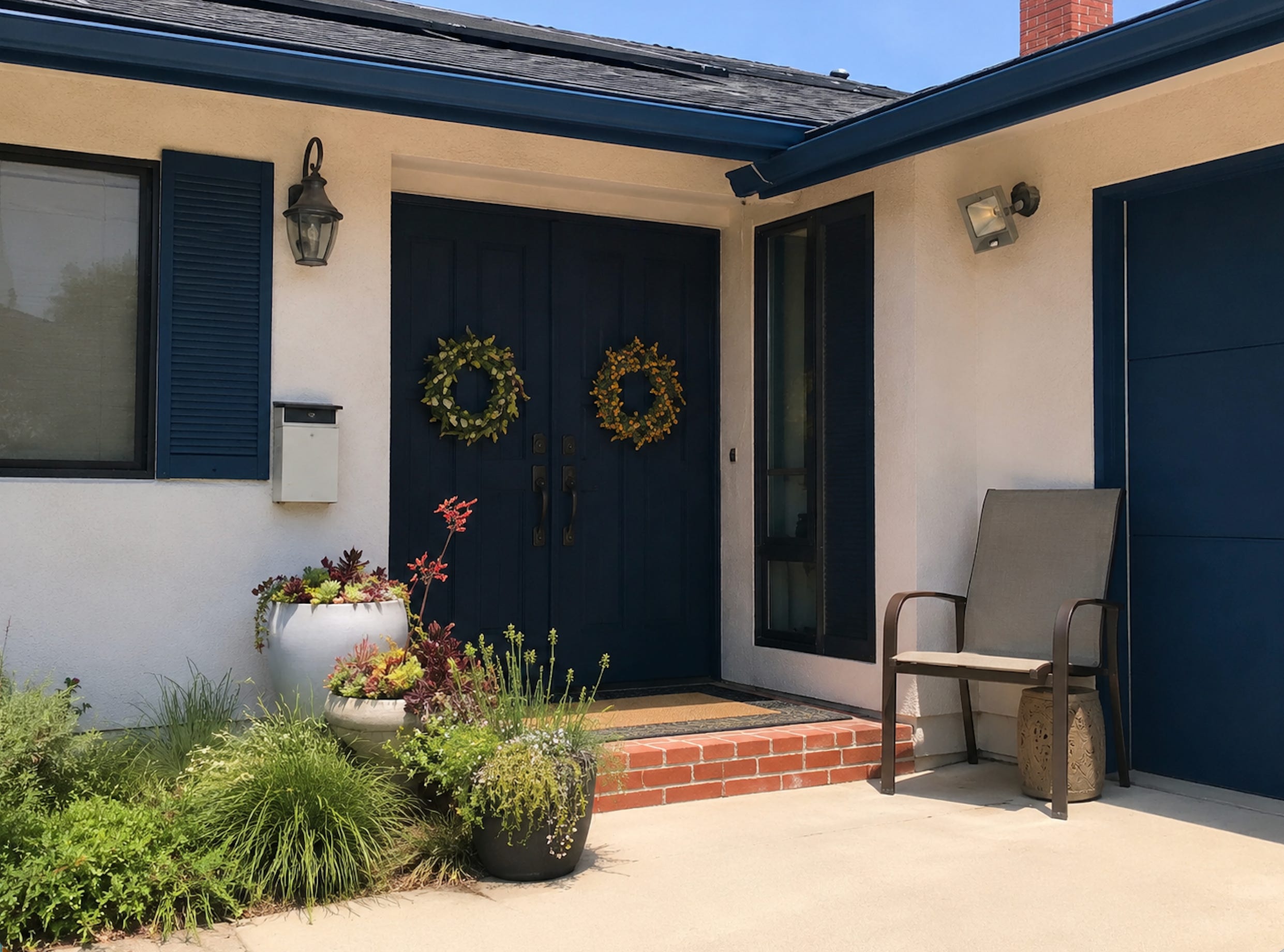
I want to tell you about this door.
It is the front door of my house, the house where I cared for my mom. There is a roughly six-inch step in front of it. One day I stood beside that step and realized I did not know how to help her get up it — even though the staff at the emergency department had just said she could do it before sending her home.
I think often about what I did not know and could not do that day. And I have never stopped thinking about another image, one I have not yet seen but cannot get out of my mind.
A professional caregiver, a home health aide, a domestic worker, someone who has spent decades in other people’s homes doing some of the most intimate and demanding work imaginable, standing at the front of a room. Teaching. Sharing what she knows about how to lift someone who cannot stand on their own, how to recognize when something is wrong before it becomes a crisis, how to be present with someone who is disappearing a little every day, how to balance respecting someone’s dignity while meeting their most personal needs.
And in the room, listening and learning, informal and family caregivers. Maybe a daughter who has been white-knuckling it through her mother’s decline, figuring things out at midnight on Google, crying in the car on the way home from the emergency department. A wife, a foot shorter and a hundred pounds lighter than her husband, needing to figure out how to help him move from a chair to a wheelchair, a bed to a commode. People who have been doing this work alone, without training, without support, without anyone asking how they are doing.
And underneath the practical exchange, the techniques, the knowledge, the skills, something else happening too. The professional caregiver being seen, finally, as the expert she has always been. The family caregiver being witnessed, finally, in the full weight of what she is carrying. Both of them, for a moment, not alone.
That exchange, professional caregiver as teacher, family caregiver as student, expertise and humanity flowing in a direction that rarely happens in American life, is the image at the center of something I have been building called The Care Circle.
How I Got Here
I have been a caregiver for most of my adult life. I know what it costs — in money and sleep and health and the future you had imagined for yourself — to carry someone you love through a system that was not designed to support either of you.
I also know what it is to be on the other side of that, to be someone making her way back from caregiving, learning to tell her own story, understanding slowly and then all at once how much power there is in that telling.
In recent weeks I have been writing, for the first time, not as a researcher or an organizer but as someone who lived it. A piece about what happens when Medicare starts paying doctors to train family caregivers and almost nobody knows. A piece about the caregiving cliff and who is missing from the sandwich generation story. Comments on LinkedIn posts from Pivotal Ventures and Caring Across Generations and a Molly Guy essay in The Cut that stayed with me.
And in all of that writing and thinking and engaging, one idea kept surfacing. The same idea, from different directions, in different forms. I kept arriving at the same question: why don’t we have a place for all of this?
The Problem I Keep Seeing
America's care economy — the market for products, services, and employer benefits that help people care for others — was valued at $648 billion in 2019, larger than the pharmaceutical industry. That figure apparently does not capture the estimated $1.01 trillion in unpaid labor provided by family caregivers annually. The true size of the care economy is far larger. Research estimates the median cost to a daughter's wellbeing of providing care to her mother at $144,000 to $202,000 over two years -- in lost earnings, reduced career advancement, and life quality -- depending on the mother's functional status. In a nation in the midst of a loneliness epidemic, caregivers are among the most isolated people carrying some of the heaviest burdens.
We know what works. Research consistently shows that coaching, peer support, and community connection reduce caregiver burden and improve outcomes. A single supportive call can meaningfully reduce caregiver distress. Programs that train caregivers reduce hospitalizations by as much as 67 percent.
And yet the gap between what we know works and what we actually do remains staggering, even as Medicare introduced new coverage for caregiver training and assessment in 2024. In the first 18 months of that program, fewer than 10,000 out of an estimated 20 to 60 million caregivers received any training help.
As the Leonard Davis Institute at the University of Pennsylvania put it plainly this month, “Relying on unpaid caregivers to hold together our long-term care system is not sustainable. And it is wrong.”
The gap is not knowledge. The gap is not evidence. The gap is infrastructure, awareness, and the will to scale what works. And underneath all of that, the gap is stories. The stories that could change minds and build political will and move the people in the rooms where caregiving decisions get made.
This is not a new idea. Storytelling has always been at the heart of community organizing, the way people move from private pain to public action. When one person names what they have carried, it gives others permission to do the same. That collective naming becomes data, becomes solidarity, becomes the foundation for change. What is different now is our growing capacity to meet the need at scale, the platforms, the networks, the virtual spaces that allow caregivers and facilitators to connect across distance and stay connected, and the infrastructure that can carry these stories further and faster than ever before.
The Other Half of the Problem
While family caregivers struggle without support or training, professional caregivers, home health aides, domestic workers, direct care workers, have also been doing this work for decades. Invisibly. For poverty wages. Without recognition, without status, without anyone treating what they know as the expertise it actually is.
They know things that hospitals and medical schools don’t teach. Things that family caregivers desperately need and cannot find anywhere else. How to read someone’s body. How to manage a difficult afternoon. How to be present without disappearing yourself.
As Ai-jen Poo, who has spent her career building the movement for domestic workers and professional caregivers, put it, “This is the work that makes everything else possible.” It is some of the most important work in our society. We have treated it as the least valuable.
That needs to change. And the change I am imagining starts with that image, the professional caregiver, finally recognized as the expert and the teacher she has always been, standing at the front of a room.
What The Care Circle Is
The Care Circle is a community-based project I have been developing that operates at three interconnected levels.
The first is storytelling. Caregivers and former caregivers coming together, in person and virtually, to tell their stories through writing, art, oral history, whatever form feels true. Facilitation is intentionally multidisciplinary: a therapist or social worker with caregiving expertise who understands that telling these stories is not just creative work but also emotional work; artists who understand that sometimes the only language equal to an experience is not words at all; and professional caregivers who bring their own knowledge and lived expertise into the room as teachers and witnesses. Art, whether visual, performing, oral, or written, is not incidental here. It is often the only language equal to what caregivers have experienced and what they need to express. This is not a support group, a writing workshop, or an arts therapy session. It is something more complete than any of them.
Deepened by peer mentorship: people who are in it find each other, validating, steadying, and accompanying one another through something that was never meant to be done alone. And people who have been through it, who are rebuilding on the other side, bring something irreplaceable: the hard-won wisdom of having carried it, the particular dignity of having their experience recognized as the expertise it became, the space to grieve what was lost, and the knowledge that it is possible to come through. Even as they bring all of that to others still in it, they find something here too: the validation, the community, and the release that most former caregivers never receive.
The second is knowledge transfer. Professional caregivers positioned as teachers and knowledge holders. Family and informal caregivers learning from them. A deliberate honoring of expertise that has long gone unrecognized, knowledge flowing from the people who have been doing this work, too often invisibly and for too little, to the people who need it most and have never known where to find it.
In many of these rooms, that will mean women of color, immigrant women, women from under-resourced communities, standing as the experts they have always been. And the people learning from them may begin to understand, for the first time, what it means that this work has been so long undervalued and underpaid. That understanding is not guaranteed. But the conditions for it will be there. And when it takes hold, it becomes the beginning of solidarity. Solidarity is the beginning of change.
Professional caregivers come to The Care Circle as teachers. But they also come as people. The work they do is physically, emotionally, and spiritually demanding. They carry grief, exhaustion, and the weight of other people’s most vulnerable moments, often with no one asking how they are doing either. Better wages, benefits, and working conditions are what professional caregivers are owed and what the movement is fighting for. The Care Circle does not substitute for that. But it can be a place where their full humanity is recognized, and where the people learning from them begin to understand, from the inside, why the fight for those conditions matters.
The Care Circle also creates a natural bridge to the Medicare caregiver training provisions that are currently going unused, providing the community infrastructure the medical system cannot build alone. It connects medical providers to community resources they too often do not have the time or infrastructure to find on their own, closing the loop between the clinical system and the community infrastructure that supports caregivers beyond the appointment.
The third is policy and advocacy. The stories compiled, synthesized, and brought to the rooms where caregiving policy gets made, where grants get awarded, where medical training gets designed. Caregiver voices not just deserving a seat at those tables but being necessary for those tables to function well. The lived expertise of caregivers valued and treated as real expertise — as hard-earned as the MBAs and MPPs, MDs and PhDs already in those rooms. Even though it is not credentialed the same way.
These three levels are not separate tracks. They are designed to be self-reinforcing. The stories become the data. The knowledge transfer builds solidarity. The policy impact creates more space for the stories and the training to grow. And running through all three, the support that caregivers so rarely receive: the experience of being witnessed, valued, and accompanied by others who understand the weight of what they carry and what they have carried.
The Care Circle is designed to start as a pilot, or a series of pilots, learning from each community what works best for them. What that looks like will vary. All women. A specific age group. Disease-specific caregivers. A community built around performing arts rather than writing. Visual art rather than oral history. The model is flexible by design because caregiving itself is not one thing and neither are the people doing it.
Why Now
The Medicare provisions for caregiver training and assessment, introduced in 2024, exist but are barely being used, the infrastructure to connect caregivers to them is missing. The Care Circle is designed to be part of that infrastructure.
The Take Me Home documentary, executive produced by Ai-jen Poo and Lydia Storie for Give Not Take Media, premieres this fall with a national listening tour designed to reach 130 million caregivers and their families. That listening tour is itself infrastructure. The Care Circle could be what comes next, the place where the stories gathered on that tour continue to be told, shared, used, and multiplied.
As Rosalynn Carter said, “There are only four kinds of people in the world: those who have been caregivers, those who are currently caregivers, those who will be caregivers, and those who will need caregiving.” The audience for this project is not a niche. It is everyone. The question is not whether this project is needed. The question is who will build it and when.
Why I Am Sharing This
I am not a filmmaker or a foundation program officer or a major nonprofit director. I am someone who has lived caregiving from the inside for decades, who is making her own comeback from those years, who began this work co-authoring research on long-term care published in the Western Journal of Medicine in 1997 and has been finding her way back to it ever since, and who sees the connections between the storytelling, the knowledge transfer, the policy impact, and the solidarity that are harder to see from inside any single lane.
I may not be the right person to lead every element of this. I am the right person to see it whole and to articulate why it matters. I am looking for the partners, the resources, and the infrastructure to make it real. This may already exist in ways I am not aware of, and if so, I want to know about it and be part of it. If it does not, I want to help build it.
If this resonates, if you are a caregiver or former caregiver who wants to be part of something like this, if you work in caregiving advocacy or policy or media or the arts and see the overlap with your own work, if you have ideas or connections or resources that belong in this conversation, I want to hear from you.
The work is there. Let’s build it together.
Sources and Further Reading
Medicare caregiver training and assessment data: AARP and ATI Advisory, Medicare caregiver training claims analysis, 2024-2025. Reported by Howard Gleckman, Forbes, May 26, 2026.
$648 billion care economy valuation: Pivotal Ventures and The Holding Company. 648 Billion Reasons Why the Care Economy Is Serious Business. July 2021.
$1.01 trillion in unpaid care annually, representing 49.5 billion hours: AARP and National Alliance for Caregiving, Caregiving in the US 2025. July 2025.
Median cost to a daughter’s wellbeing of providing care to her mother: $144,302 to $201,896 over two years: Coe NB, Skira MM, Larson EB. A Comprehensive Measure of the Costs of Caring for a Parent. Journal of the American Geriatrics Society, 2018.
“Relying on unpaid caregivers to hold together our long-term care system is not sustainable. And it is wrong.” Rachel M. Werner, Executive Director, Leonard Davis Institute, University of Pennsylvania. America’s Caregiver Crisis is Burning Out Millions of Families, May 28, 2026.
67% decrease in patient hospitalizations associated with caregiver self-care improvement: Bidwell JT, Quinn R, Hirschman KB, Riegel B, et al. Supporting Family Caregiver Health in Heart Failure. Journal of Cardiac Failure, March 2026.
Rosalynn Carter quote: The Rosalynn Carter Institute for Caregivers.
“This is the work that makes everything else possible.” Ai-jen Poo, National Domestic Workers Alliance and Caring Across Generations.
Take Me Home documentary: Give Not Take Media, executive producers Ai-jen Poo and Lydia Storie. Theatrical release fall 2026.
Brody BL, Simon HJ, Stadler KL. Closer to Home: The British Columbia Long-Term Care System in Transition. Western Journal of Medicine, 1997. https://pmc.ncbi.nlm.nih.gov/articles/PMC1304620/