
The 2028 Los Angeles Olympics open in less than two years.
In today’s world, that feels simultaneously like tomorrow and forever away.
By the time the torch is lit in Los Angeles, the United States will be well into a presidential election campaign season. We may still be at war abroad. We will still likely be a divided nation on many issues.
Athletes competing at LA28 will do so in what may be the most politically charged Olympic environment in American history. On home soil. In Los Angeles, California. Under maximum scrutiny. In a state the sitting president has repeatedly targeted and made no secret of disliking. Every medal, every interview, every social media post, every celebration will unfold against that backdrop.
For female athletes, the pressure and scrutiny will be even greater. Because they always are for women.
But the opportunity will be greater as well.
How are they getting ready for it? Who has their back? What can the rest of us do now and then?
The 2026 FIFA Men’s World Cup gave us a preview.
President Trump personally called FIFA president Gianni Infantino and asked him to review the suspension of U.S. striker Folarin Balogun following a red card. FIFA subsequently suspended the one-match ban, allowing Balogun to play. The U.S. lost to Belgium, 4–1.
The call, far more than the loss, dampened the goodwill and feeling of community the World Cup had built. The day after FIFA’s decision, on Welcome to the Party, Glennon Doyle said, “They need to call the WNBA. I feel like the WNBA would know what to do.”
She was right.
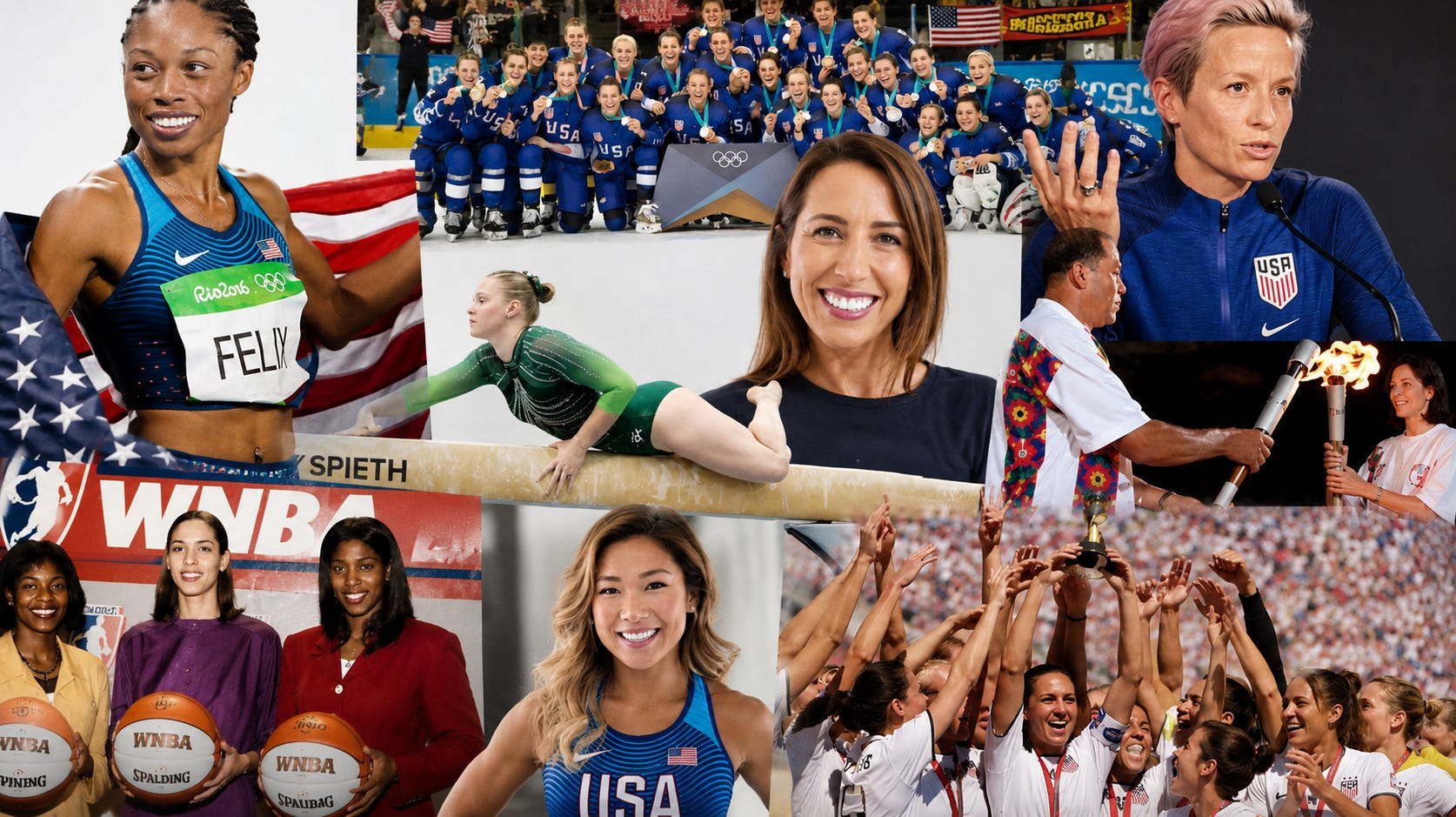
The WNBA has spent 30 seasons discovering how to navigate hard things — race, politics, culture, activism, conflict — while still building a league and a community. The same could be said for the USWNT and the generations of women who have made it a global model. Or the 2026 Olympic champion women’s hockey team.
Call the women. They have been traversing this kind of turmoil for as long as they have been on the fields and in the arenas.
And the athletes of Team USA in LA28 will need every bit of that experience and wisdom.
The U.S. Women’s National Volleyball Team released a public statement about the IOC’s genetic testing mandate for female athletes. They complied with the mandate, but raised concerns about transparency, due process, the privacy and security of their genetic information, and the failure to involve athletes in the process from the start.
“The nature of this mandate placed athletes in an impossible position: submit to invasive genetic screening or risk losing the opportunity to compete in the sport and profession to which we have dedicated our lives.”
They ended with this:
“Athletes should be a part of the conversation and the construction of new systems from the start, not met with silence, ambiguity, or pressure to comply without question.”
The statement received almost no coverage. But put that statement out in the summer of 2028 — when policies around trans women athletes will still be politicized, when the IOC’s genetic-testing policy will determine who is eligible to compete in women’s events, when the issue will be weaponized at every turn, and the scrutiny could be intense.
The U.S. women’s hockey team found themselves navigating this in real time after winning Olympic gold this year. Trump invited them to his State of the Union address only after joking during a call with the men’s gold-medal team that he would have to invite the women too or risk being impeached. The women politely declined, citing existing academic and professional commitments.
They handled it with grace. What they did and said could be part of a blueprint for the women of LA28.
But who is building and sharing that blueprint?
Meg Linehan, the most prominent women’s soccer reporter in the country, wrote in The Athletic that the USWNT, as total bystanders in the World Cup red card phone call controversy, “might also end up unexpected victims down the line.”
The women did nothing wrong. They may pay part of the price anyway.
That is part of what athletes need to be prepared for too. Not only the choices they make, but the choices other people make that they may be asked to answer for.
Political pressure. A president who will claim every American medal and use the Games as an instrument for political manipulation, whether athletes want to be part of that or not.
Governance pressure. An IOC whose credibility has repeatedly been challenged, but whose decisions athletes will still have to live with.
Media pressure. A home Olympics in Los Angeles, with attention unlike anything most of these athletes will have experienced.
Cultural pressure. A presidential campaign and its accompanying culture wars unfolding around them, with the Olympics, and the Olympians themselves, inevitably offered as evidence for competing ideas of what America is and should be.
Female athletes will be asked to compete, to perform at their best, in the moments they have dreamed of their entire lives, in the middle of it all.
Billie Jean King famously says, “pressure is a privilege.” And it is. These athletes have earned the opportunity to compete on the biggest stage in the world. But they’ve spent years preparing for the pressure on the court, the field, the track, the pool, the gym. It’s everything beyond those confines that they may not be adequately prepared for.
They will be asked to win, to be gracious in defeat, to represent their country, to be patriotic, to take stands, to stay in their lane, to speak up, to stay quiet, to be role models, to smile, to just play the game.
They will all do their best to handle those moments beautifully. But why should they have to take them on un- or underprepared?
They deserve better than having to figure it out in the heat of the moment.
Megan Rapinoe, who Julie Foudy said taught a master class at any FIFA event — who could slam the organization with a smile while its executives sat in front of her and laughed because they knew she was right — said recently that she didn’t always feel comfortable in that space. She had to grow into it.
“If you don’t own it, then it starts to run you,” she said.
The players coming up can’t assume that confidence will simply appear when the moment does. Rapinoe’s advice to the current USWNT could apply to every LA28 hopeful: start stepping into it now.
She described what can happen when a player suddenly breaks through at a major tournament: “Every single media outlet every single day. Social media is going to be crazy.”
Rapinoe put it in terms of having “two parts to your job.” The first, she said, “is on the field always.” The second is everything that comes with it.
And you don’t know who is going to “pop off.” She was speaking about a World Cup, but the same holds for an Olympic Games. The stars of LA28 may be athletes nobody has heard of yet. Some won’t even know they are Olympians until shortly before the Games.
They all deserve preparation.
And the point of that preparation should not be to tell athletes what to think, what to advocate for, or what to say. It should give them enough knowledge, practice, support, and community to decide those things for themselves and feel comfortable acting on their decisions.
An athlete should be prepared to speak if she wants to speak. To advocate if she wants to advocate. To say no if she wants to say no. To know who she can turn to for support and counsel. To recognize when someone else is trying to use her or her accomplishments for a purpose she didn’t choose.
The decisions should be hers. The preparation makes that possible.
What could that preparation look like?
Strategic: What are the specific political and governance scenarios female athletes may face? What has happened to athletes who have spoken, who have stayed silent, who were caught in controversies they didn’t create?
Knowledge: When the first trans woman tennis player was close to joining the WTA, Billie Jean King invested time studying the emerging science and policy around trans athletes and helping the other women on tour deepen their understanding. The same instinct to study and learn applies now to all the big issues that aren’t already in an athlete’s wheelhouse.
And those issues go well beyond trans women. Geopolitical conflict. IOC governance. The inclusion of Russian athletes despite the continuing invasion of Ukraine. The US war with Iran.
Athletes don’t need to be experts in any of this. But being prepared to do their best may also mean knowing how they want to handle these questions if they come up.
Psychological: What does it feel like to compete on home soil under this level of scrutiny? How did the women of Team USA handle it in previous home Olympics? And how might it be different in today’s instant social media ecosystem? Which sports psychologists and other experts are available who understand not just athletic performance, but the intersection of that performance with the media demands on athletes, especially within the political and cultural weight of this particular moment?
Community: The athletes who have been through comparable moments, generations of USWNT members, the 2026 women’s hockey team, and so many more, would be valuable mentors for the athletes working toward LA28.
This shouldn’t be a panel or a one-time conversation. It should be an ongoing exchange.
The knowledge that exists in those women needs to transfer deliberately, starting now and going through the Games.
Advocacy: Athletes need to know their rights: with their federations, with the IOC, with the media, with their sponsors. They need advocates already available when things go wrong, so they are not scrambling to find support in real time.
Practice: Time and space to become more fluent and confident: in speaking about themselves, in understanding the landscape, in deciding what they want to advocate for, what they don’t, and how they want to respond when they’re pulled into something they never chose.
Getting comfortable before the pressure arrives. Because once it does, there is no time.
And being prepared can help them navigate through the storms and capitalize on the opportunities.
So who should be doing this work, and is anyone?
LA28 has established an Athletes’ Commission, eighteen Olympians and Paralympians, chaired by Janet Evans, including Allyson Felix, Ibtihaj Muhammad, and Scout Bassett.
But this goes beyond logistics and athlete services. Political and cultural preparation may fall outside the Athletes’ Commission’s mandate.
The USOPC has athlete services and may have resources to support exactly this kind of preparation. The Women’s Sports Foundation supports female athletes on and beyond the court and the field. The WNBA Players Association has the institutional knowledge Glennon Doyle was pointing at. The 99ers and generations of USWNT veterans fought for much of what current players are inheriting. They have hard-earned wisdom that needs to be shared.
And that list is hardly exhaustive. Across sports and generations, there are women who have already been through similar moments. They know things the next generation should not have to learn from scratch.
Philanthropic organizations investing in women’s leadership and advancement could help fund and convene the work.
So too could the corporations currently benefiting from their investments in women’s sports. Those corporations have something to gain too. If the women of Team USA are prepared for both the challenges and the opportunities of the Games, their sponsors will also benefit.
The preparation for both overlaps. Funding it now is an investment.
Is any of this happening?
It may be, privately, in ways not visible from the outside.
I hope it is. If you know, I’d genuinely like to know too.
If it isn’t, then we are asking them to carry too much of this without enough support.
And that is where the rest of us come in.
We don’t all need to be part of the prep. But we can ask whether the prep is happening. We can ask who is funding it, who is facilitating it. We can encourage the people and organizations with the resources to step up. We can try to connect people who should know each other to share the knowledge that already exists, and help prevent another generation from learning everything the hard way.
And when the Games arrive, we can remember something else. These women are athletes before they are symbols, and they are human beings before they are athletes.
They don’t owe us a position on every controversy. They don’t owe us the answers we want. They don’t owe us their participation in every political or cultural fight that lands at their feet.
But if we’re going to ask them to represent our country, inspire the next generation, grow their sports, and somehow navigate everything that comes with it, the least we can do is make sure they have all the tools they need to do it all.
They deserve the preparation and support to make those choices for themselves. We all have to have their backs.
And preparation isn’t only about what could go wrong.
Imagine what could go right.
The Atlanta Games in 1996 have been called the first Title IX Olympics, the moment when a generation of American women who had grown up with opportunities created by the law arrived on the Olympic stage. Women’s soccer made its Olympic debut. American women won gold in soccer, basketball, gymnastics, and softball. The WNBA launched the following year.
John Speraw, USA Volleyball’s Director of National Teams, recently compared the 2027 FIVB Volleyball World Championships in the US, a year before LA28, to the 1999 Women’s World Cup that launched women’s soccer into the American mainstream.
“We hope that’s analogous,” he said. “How can we have a similar impact?”
LA28 has that potential for many women’s sports.
Professional volleyball, lacrosse, flag football — sports that are growing fast and could reach entirely new audiences and deepen connections with existing audiences on a home Olympic stage.
The women of LA28 will have opportunities that extend far beyond the podium and far beyond 2028.
But only if they are prepared for everything that comes with it.
The torch hasn’t been lit yet.
There is still time.
The work starts before the opening ceremony.
It starts now.